Monday, July 18, 2011

Inventory Overview: OPC Carousels


Hello everyone, I hope you are having a great summer! Today I am going to describe to you pharmacy inventory at the University of Michigan Hospital. To begin, the hospital receives it's shipment of medications almost exclusively from the largest wholesale pharmaceutical distributors: AmerisourceBergen, McKesson HBOC Inc., and Cardinal Health Inc. After delivery by either FedEx or UPS, it is up to pharmacy inventory carefully unpack the medications and place them on hospital transportation carts according to lot number. Why did I say carefully? This is because medications arriving to the hospital have specific conditions in which they have to handled. For instance, some medications arrive in Styrofoam refrigerated boxes and need to be placed in the refrigerator immediately after delivery. Other medications can be left at ambient temperature. Another important consideration is the handling of chemotherapy drugs. These drugs must be handled with great care as they can cause very hazardous conditions if exposed/opened up to the atmosphere and can even become deadly by destroying the human body's normal functioning cells. With chemotherapy drugs, safety is key! Once all the medications are unpacked onto the carts, they are scanned into an inventory-recording software call Omnicell. After scanning the bar-code of each medication, a sticker is printed out and placed on the medication indicating inventory personnel the storage location of the drug.
Alright, so all of this might sound very mundane but I haven't written about the coolest part yet: The UofM pharmacy department's OPC inventory control system! Continuing from the previous section, when the label prints, it often calls for the medication to be stored in one of three pharmacy department OPC carousels. Each of these so-called carousels span three stories high and operate four meter long horizontal storage shelves for drug storage. When receiving and stocking medications from initial inventory control, the carousel shelves move vertically, away from the user and into the ceiling. Additional shelves rotate up from the ground to the user controlling the carousel. To get a visual of the OPC carousel, I have included a picture. If you are somewhat of a technical or mechanical enthusiast, this machine is certainly one that will make your gears turn!
Aside from receiving and storing hundreds of medications each day, inventory is also responsible for replenishing "arrest" boxes that are returned from the hospital's various units. The hundred arrest boxes can be returned to pharmacy inventory for two reasons. First, the box could be used in an event of emergency and need its stock medication replenished. Second, the box could contain a medication that has expired and needs to be replaced. Medications that are included in these arrest boxes include amiodarone, naloxone, epinephrine, norepinephrine, magnesium sulfate, phenytoin, glucose, lidocaine, and calcium chloride among others. The arrest boxes also include multiple-gauge needles, multiple-volume syringes, IV piggyback bags, and IV base dilution solutions such as sodium chloride and sterile water. In summary, these kits are essential in the event of an emergency occurring anywhere in the hospital.
Overall, inventory has been a great experience for me. While not heavily clinical, I have learned a great deal about the logistical side of medication distribution and supply. For a majority of inpatient settings, patient care and recovery would be impossible if it weren't for the operation of a pharmacy inventory department indicating its immense importance. Stay tuned for my next blog entry that will include my patient-triaging experience!

Wednesday, July 13, 2011

Signing Out From Boston!

Hello friends!! The summer is winding down and this is the last post you are going to see from me here. Fear not- if you miss me you can head on over to the P4 rotation blog to catch up on all of my latest adventures! I cannot believe how quickly this summer went- three months just isn’t enough (sorry to all the rest of the classes who won’t even have that!)


This summer I have been working to develop a couple of quality improvement projects. The first one focused on stroke prevention in atrial fibrillation. Basically, the guidelines say that if a patient with atrial fibrillation is at risk for stroke they should receive oral anticoagulation (traditionally with warfarin). This becomes quite difficult in our members, however, as they are all elderly and many are disabled. They have difficulty complying with the monitoring requirements of warfarin, are often treated with interacting medications and are also at a high risk for falls and subsequent bleeds. With the approval of the new direct thrombin inhibitor, dabigatran (Pradaxa) in October, our clinicians now have another option for anticoagulation in this population. We identified members who had a diagnosis code for atrial fibrillation and determined their stroke risk through the use of a CHADS score (this looks at whether a patient has congestive heart failure, hypertension, is over age 75, has diabetes or has had a previous stroke). We were able to use pharmacy data in order to determine whether they were receiving warfarin, dabigatran or aspirin and from this, we developed our best guess of which patients could benefit from therapy with dabigatran. I worked to create educational material for our clinicians and to draft communications to be sent out to each of the identified patients’ primary care physician. Next year they will pull this data again and see whether a higher percentage of patients are now being appropriately anticoagulated. I wish I were staying longer so that I could be involved in the education efforts and to see the effect that all of these efforts have on patient care!

I’ve also been working on some smaller projects. I have created reports to send out to all of the different sites regarding patient adherence and cost effective prescribing. I drafted letters to be sent out to our members (after CMS/MassHealth approval of course!) regarding MTM services and regarding changes in coverage. I also drafted communications to our clinicians regarding the new simvastatin dosing guidelines.


My final project has been attempting to develop a polypharmacy quality improvement project. So far, I have done a literature review of all the different tools that exist to assess polypharmacy (this turned out to be a huge amount of information!) Tomorrow I’ll be meeting with our pharmacy director and the medical affairs department so that we can develop criteria for the identification of members to target and what intervention we can use. We will also need to identify indicators so that we can assess the progress of the project after implementation. I will definitely not be around when this project is rolled out but I have still learned so much from working on it!


I have enjoyed my summer at CCA immensely! I love thinking about the unique pharmacy issues that the elderly population faces and am definitely thinking about steering my career in that direction. I can’t wait for my rotations coming up this year where I can start to delve into this interest- see me jumping for joy?!

Tuesday, July 12, 2011

The INR won't budge from 6, that's therapeutic right?

So last post I left a teaser of how my first tour on clinical duty at the hospital would pan out.

At Wyandotte, the inpatient (IP) pharmacist staff is not sub-specialized to different departments like bigger hospitals (although we are trying to hire in an ID specialist). All the pharmacists rotate between order entry and typical IP maintenance, and clinical duty for the floors. Most of the time they will be upstairs in the various pharmacy offices for the floors, but if we're short on a given day they will just manage clinical from the clinical office in the IP pharmacy.

I started out my first clinical day in the clinical office the entire day, because that day happened to be a short staff day...and the clinical manager who was going to train me got in a car accident that morning. So I was pretty much stuck reading the pharmacy policies regarding dosing guidelines the rest of the day. That day was just boring except for one part. The clinical care coordinator and our new P4 were going over sticky details of how to best administer liposomal amphotericin B for a new admit, who had happened to just come in from a double lung transplant and wouldn't be able to use the common nebulizer for the amphotericin. The answer was pretty inventive; using a certain type of open-air nebulizer and a negative pressure room. The logistics behind this decision actually require some of the engineering department to get in on the discussion. Unfortunately I never did get to see how that worked out.

The rest of the first month or so went much better and I would rotate with the floor pharmacists and basically train on each floor. Aside from answering questions on everything the medical and nursing staff can throw at us, the main priorities the floor pharmacists have are to monitor the anticoag and antibiotic therapies of the patients on their floor. The most difficult and time consuming I would learn, Coumadin, was also the most fascinating.

Coumadin therapy is rather straightforward; for a given risk of developing clots, Coumadin is prescribed (sometimes with bridging heparin) to decrease this risk. In almost any case that isn't a post-op, these patients will be on Coumadin for years if not the rest of their lives. And Coumadin is scary. The therapeutic interval is extremely small, and there's a fine line for if the INR is 1.0 too low, there’s no effect, and 1.0 too high, the patient will bleed. Add to this the fact that pretty much everybody responds to Coumadin differently and hundreds of medications interact with it, Coumadin is a headache for even veteran pharmacists.

There are guidelines for how to deal with dosing Coumadin (if INR goes up, do this to dose, etc.) but they have proven to be useless for how many interindividual differences there are. One pharmacist explained it best to me; heparin therapy is like checkers, defined moves and each move has its direct consequence, and you can only go forward and back. Coumadin is more like chess; we have to think 3-4 steps ahead each dose just to attain a simple form of steady state (which by the way, the INR will never be at a steady state unless you have the text book patient, which by the way you will never have). Predicting how a patient may react is also key, but sometimes misleading. At first glance, an 85yo lady on synthroid and amiodarone might look like a 1mg patient, but then you realize it takes almost 15mg a day to keep her therapeutic. Or a 45yo 150kg male might get an INR of 5 from his first 2mg dose. To say the least, Coumadin therapy is tricky, but never, never the same.

VA Ann Arbor Pharmacy Residency Program

Most of my work this summer has been with the residency program director. We have been gathering ideas for research projects and putting together necessary information for the new residents who started July 1st. They came from the Universities of Nebraska, Connecticut, Maryland, and Purdue. It has been fun getting to know them. Last Friday, I gave them a tour of the University of Michigan Hospital and the College of Pharmacy. During our travels I was able to ask lots of questions about residency and interviews. A residency is a great way to expand your clinical knowledge and abilities as a pharmacist. I have heard it described as “your P4 year on steroids.”

The VA offers four ASHP accredited PGY1 pharmacy resident positions per year. The program emphasizes ambulatory care opportunities in a largely geriatric, male patient population. The residents engage in monthly rotations, research projects, staff in-services, journal clubs, precepting students, and other teaching activities. The core rotations include ambulatory care (4 months), acute patient care (2 months), distributive skills, drug information, administration, and elective(s) at the VA or the University of Michigan Hospital. There are a variety of ambulatory clinics at the VA, including a Pain Medication (Integrative) Clinic, Geriatrics Clinic, Palliative Care Clinic, Primary Care Clinic, Home Based Primary Care Program, and Anticoagulation clinic. If you like ambulatory care, the VA is the place to be.

My main project this summer has been the creation of an informational residency website. Due to some administrative back log, I will not be able to finish it during the summer so I will be coming back during the fall semester to finish it up. Creating the website has given me a great overall picture of the Ann Arbor VA residency program and its rotations and preceptors.

My summer internship at the VA has been a rewarding educational experience. I have worked with a variety of pharmacists on projects ranging from MUE’s to RCA’s. I would recommend it to anyone interested in expanding their overall knowledge of hospital pharmacy through project work.

Sunday, July 10, 2011

Go to your room!

Greetings once again, avid readers, to Regulatory Affairs 101. Last time, we spoke about good and bad direct-to-consumer print advertisements. Today, we’ll speak about what happens when we don’t follow what our mothers tell us. Of course, when I say mother, I mean the FDA’s Division of Drug Marketing, Advertising, and Communications (DDMAC), AKA “The Enforcer” of advertising and promotion. They’ll send out two types of letters, a Notice of Violation or a Warning Letter, depending on whether you deserve a timeout or a thorough grounding.

“You’re In Timeout!”
Let’s start with the less serious problem—a Notice of Violation. These are written by DDMAC reviewers and are typically addressed to a regulatory affairs employee of a pharmaceutical company. They follow the same typical format:
  • Dear [Name of Regulatory Professional]
  • Background of drug (e.g. indications and usage)
  • You’re in timeout because…
  • …and you’d better stop in 14 days.
Violations usually fall in several distinct categories:
  1. Overstatement of efficacy
  2. Unsubstantiated claims
  3. Omission/Minimization of Risk
  4. Broadening of indication
  5. Any other category DDMAC deems violative
So what do these letters mean to pharmaceutical companies? Well, it hurts their reputation, they lose revenue in destroying and recalling the violative material, and they also lose revenue due to lack of promotion. These letters are then published to set precedence for other pharmaceutical companies.

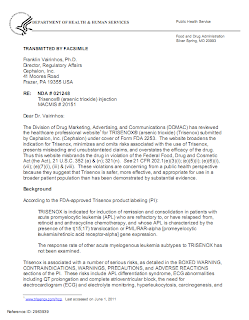
Click on the thumbnail below to view the most recent Notice of Violation letter from June 21, 2011 for Trisenox (arsenic trioxide).


“You’re Grounded!”
Ah yes, the infamous Warning Letter. These are given out to companies that have advertising and promotional material that may cause more serious threats to the public health. Recall that Notices of Violation are written by DDMAC reviewers and are addressed to a regulatory affairs employee. For Warning Letters, these bad boys are signed by the Director of DDMAC himself, Thomas W. Abrams, RPh, MBA, and are addressed to the CEO of the company to emphasize leadership accountability.

The letters follow a similar format of a Notice of Violation with slight changes in italics:
  • Dear [Head Honcho of Company]
  • Background of drug (e.g. indications and usage)
  • You’re grounded because…
  • …and you’d better stop in 14 days. PS fix the problem.
This means that if you spent $4M on a violative TV advertisement, you’re going to be spending an additional $4M on a separate TV advertisement “to disseminate truthful, non-misleading, and complete corrective messages” [direct quote from recent Warning Letter].

Click on the thumbnail below to view the most recent Warning Letter from May 6, 2011 for Vyvanse (lisdexamfetamine dimesylate) capsules.


Okay folks, that’s it for this installment of Regulatory Affairs 101. Tune in next time for our next lesson on TV ads. Remember kids, stay in school and always listen to your mother.

Eric Zhao

I am currently a summer intern in the Regulatory Affairs Department, and the opinions and positions expressed are my own and don’t necessarily reflect those of Abbott Laboratories.

Wednesday, July 6, 2011

Pediatric Satellite Pharmacy

Whenever I get a chance to work some overtime, I often spend time in Beaumont's pediatric pharmacy. This satellite is located in the Children's hospital, which features pediatric inpatient beds, neonatal and pediatric ICUs, and a surgical center.

Understandably, a major difference between this pharmacy satellite and others is that there is a daily "batch" of liquid medication doses to be syringed up for the patients. This task can test really test your attention to detail- doses range from 0.05ml to over 10ml, so its important to check yourself with each syringe (especially when drawing them up at the end of a 10-hour shift!). Another layer of detail  includes noting the number of syringes required for a set of twins (or even triplets). It can be less than straightforward, especially when BabyBoyA requires 1 dose at 1.36ml and BabyBoyB requires 2 daily doses at 0.645ml, for example.

In addition to the liquid medications, there are typical stat orders and IV compound mixtures to be made throughout the day. Other unique responsibilities involve drawing up propofol syringes for procedures, making IV Remicaide, weighing out PEG powder, and compounding starter TPN bags.

Generally, its imperative to appreciate the different dosing required for pediatric patients, as this becomes readily apparent after spending most workdays filling adult doses.

Tuesday, July 5, 2011

“Insurance = Evil”? Think Again.


Hi all! My name is Tony Lin and I will be a P3 in September. I apologize for those that have been dying to hear how “brain-washed” I am with my Managed Care (aka insurance company) internship…it’s better being late than never!


This summer I will be interning at Blue Cross Blue Shield of Michigan (BCBSM) Department of Pharmacy Services.


Perhaps for those that have worked in community pharmacy (or from your own personal experience), many people often view the insurance companies as these evil groups that never seem to pay for any drugs for the patients. To tell you that any “Prior Authorization” or “Rejection” messages are being displayed on your pharmacy computer screen only after complex logical calculations might be hard for you to believe. Well, the analogy I would use here is that many people think all pharmacists ever do is count pills—try again…it IS more complicated than just that!


In a nutshell, an insurance company (aka a Health Plan) pools financial resources together from clients (such as your parents’ employers) and use them effectively in paying for the claims (prescription drugs in our case) filed by beneficiaries. With limited resources, strategies must be implemented to be cost-effective.


While most of the public think that drugs are like cars—the newer the better, us pharmacists know better and realize that it is not always the case. Many drugs can easily cost hundreds or thousands of dollars per prescription or per unit. This is why insurance companies set Prior Authorization in place, ensuring generic drugs (which work just as well as brand names) or other more inexpensive alternatives have been tried first.


My specific duties this summer are to be with the Pharmacy Network team. The team prepares, reviews and manages all contracts from pharmacies in the state of Michigan. No—Blue Cross isn’t the DEFULT insurance for anyone. And yes—each individual pharmacy (chain or independent) must set up specific contract with BCBSM in order to serve patients with Blue Cross plans. More on this will come as the summer goes on.


I’m going to leave you all with few “Blue” Fast Facts:

** Total Employees: 7000 (3000 employees just moved their offices to downtown Detroit from Southfield to join the existing 3000 employees that were already in the city)

** Members: 4.3 million

** Claims paid in 2009: $19.8 billion ($5 billion paid in pharmacy claims)

** 50 million pharmacy claims annually


Did you know?

** Nearly 92 cents from every dollar BCBSM collects in premiums goes to pay for health care services.

** Of the nearly 30,000 doctors in Michigan, more than 99 percent participate with the Michigan Blues.

** Nearly 2,400 pharmacies in Michigan participate with Blues plan prescription drug coverage programs.

** There are 159 hospitals in Michigan. They all participate with the Michigan Blues and accept the Blues member ID card for health care coverage.