Showing posts with label industry. Show all posts

Friday, July 29, 2011

Rx on TV

Hey all,

Even though last week was my last day in the office, I want to post one last time and provide some closure on the internship. In my previous post, I promised a session on TV advertisements, and (because I hate breaking promises) you will find it somewhere in the blog post.


PRESCRIPTION DRUG TELEVISION ADVERTISEMENTS

Have you ever turned on the telly and accidentally ended up on Good Morning America or CNN (HA…“accidentally”)? If so, you may have noticed a commercial featuring a woman doing yoga and the drug, HUMIRA® [adalimumab].


Yup, I spent a good part of my internship discussing this commercial with the rheumatology team, and I will be available next week for autographs [/brag]. But seriously, the amount of work and compromise that goes into making one television commercial is mind-boggling. Not only that, but companies have to follow the FDA Drug Guidance on Consumer-Directed Broadcast Advertisements and the Draft Guidance on Presenting Risk Information in Prescription Drug and Medical Device Promotion.

I shall break those down into three easy payments*: Adequate Provision,
Major Statement, and Other Nuggets. *Not all-inclusive of requirements

Adequate Provision

Along with the broadcast itself, the ad must make “adequate provision” for disseminating approved package labeling (read: drug information). There are no official right or wrong ways to ensure this provision, but companies typically (and should) provide the following four:

  1. Toll-free number: provides drug information and an option to get labeling mailed to the patient
  2. Referral to print material: “Please see our ad in blah blah magazine”
  3. Referral to healthcare providers: “Ask your doctor or pharmacist for more information”
  4. Website: "www.saynotodrugs.com"
For visual examples of the above, I randomly chose a Plavix television ad.


Toll-free number and referral to healthcare providers


Referral to Print Material


Website

Major Statement
As mentioned in my earlier posts, print advertisements include a printed Brief Summary of side effects, contraindications, and effectiveness. TV ads, on the other hand, present this information using what is known as a Major Statement—an audio or audio/visual alternative in layman’s terms to presenting risk information.


Example of Major Statement: “This drug is indicated for moderate to severe fractures of the clavicle. When taking this drug, you may experience side effects of nausea, vomiting, diarrhea, and loss of dignity. Don’t take this drug if you desire to play an integral role in society.”


Other Nuggets

The above two requirements cover a majority of the risk information, but there are other nuances that go into TV ads. I’ll just bullet them because they are easier to read.
  • Superimposed text should be easy to read and contrast well with the background
  • Superimposed text should be onscreen long enough to read and understand
  • Background music should be comparable in volume and should not be distracting
  • Avoid distracting graphics: busy scenes, frequent cuts, vivid visuals, moving camera angles
That’s about the gist of the TV ad requirements. As always, there are more regulations to cover, but I just wanted to go over the main topics. If you’re like me, watching these ads on TV will never be the same.

THE ABBOTT INTERNSHIP

This internship exceeded all expectations. I urge everyone thinking about a future in the pharmaceutical industry to apply and check it out. Even if you’re not interested in the industry, apply and check it out—you may be pleasantly surprised. There are a lot more pharmacists in the industry than you think, especially in medical information, medical review, and regulatory affairs. In these departments, you are surrounded by very intelligent people (shout out to my managers, fellow interns, and the regulatory affairs department) who put their medical background to use on a daily basis to, ultimately, ensure patient safety. Five stars: *****.


Eric Zhao


PS Be sure to check out my new posts at: On Rotation: Life as a Fourth-Year University of Michigan PharmD Student.


I am currently was a summer intern in the Regulatory Affairs Department, and the opinions and positions expressed are my own and don’t necessarily reflect those of Abbott Laboratories.

Sunday, July 10, 2011

Go to your room!

Greetings once again, avid readers, to Regulatory Affairs 101. Last time, we spoke about good and bad direct-to-consumer print advertisements. Today, we’ll speak about what happens when we don’t follow what our mothers tell us. Of course, when I say mother, I mean the FDA’s Division of Drug Marketing, Advertising, and Communications (DDMAC), AKA “The Enforcer” of advertising and promotion. They’ll send out two types of letters, a Notice of Violation or a Warning Letter, depending on whether you deserve a timeout or a thorough grounding.

“You’re In Timeout!”
Let’s start with the less serious problem—a Notice of Violation. These are written by DDMAC reviewers and are typically addressed to a regulatory affairs employee of a pharmaceutical company. They follow the same typical format:
  • Dear [Name of Regulatory Professional]
  • Background of drug (e.g. indications and usage)
  • You’re in timeout because…
  • …and you’d better stop in 14 days.
Violations usually fall in several distinct categories:
  1. Overstatement of efficacy
  2. Unsubstantiated claims
  3. Omission/Minimization of Risk
  4. Broadening of indication
  5. Any other category DDMAC deems violative
So what do these letters mean to pharmaceutical companies? Well, it hurts their reputation, they lose revenue in destroying and recalling the violative material, and they also lose revenue due to lack of promotion. These letters are then published to set precedence for other pharmaceutical companies.

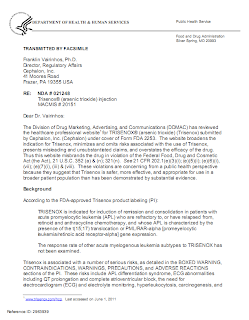
Click on the thumbnail below to view the most recent Notice of Violation letter from June 21, 2011 for Trisenox (arsenic trioxide).


“You’re Grounded!”
Ah yes, the infamous Warning Letter. These are given out to companies that have advertising and promotional material that may cause more serious threats to the public health. Recall that Notices of Violation are written by DDMAC reviewers and are addressed to a regulatory affairs employee. For Warning Letters, these bad boys are signed by the Director of DDMAC himself, Thomas W. Abrams, RPh, MBA, and are addressed to the CEO of the company to emphasize leadership accountability.

The letters follow a similar format of a Notice of Violation with slight changes in italics:
  • Dear [Head Honcho of Company]
  • Background of drug (e.g. indications and usage)
  • You’re grounded because…
  • …and you’d better stop in 14 days. PS fix the problem.
This means that if you spent $4M on a violative TV advertisement, you’re going to be spending an additional $4M on a separate TV advertisement “to disseminate truthful, non-misleading, and complete corrective messages” [direct quote from recent Warning Letter].

Click on the thumbnail below to view the most recent Warning Letter from May 6, 2011 for Vyvanse (lisdexamfetamine dimesylate) capsules.


Okay folks, that’s it for this installment of Regulatory Affairs 101. Tune in next time for our next lesson on TV ads. Remember kids, stay in school and always listen to your mother.

Eric Zhao

I am currently a summer intern in the Regulatory Affairs Department, and the opinions and positions expressed are my own and don’t necessarily reflect those of Abbott Laboratories.

Monday, June 6, 2011

Prescription Drug Print Advertisements

Clearance at last! It only took a month of negotiation, but I can finally put my thoughts on the world wide web. Now, please grab some popcorn while I attempt to entertain you for the next 2 minutes and 14 seconds:

Fellow pharm animals,

Remember pharmacy law? Let’s kick it up a notch. With all these acts and regulations, who can keep up? That’s right. We do. As part of the Regulatory Affairs – Advertising and Promotion division of a large healthcare company in the midwest, we make sure that all promotional materials going out to you (the consumers) and to you (the healthcare professionals) are marketed safely and accurately. This means that ads adequately convey the drug’s labeled indications and do not contain misleading information.

Let’s start with an example of a well-designed print advertisement about the fictional drug, Arbitraer (Source: FDA DDMAC website):

What makes this a good ad?

  1. Correctly identifies brand (Arbitraer) and generic (misvastatium) names
  2. Accurately claims an FDA-approved indication
  3. Appropriately states Arbitraer is given by prescription only
  4. Provides “fair balance” about risks and benefits
  5. The man on the beach is in the approved age range of the drug
  6. Encourages reporting of adverse events to FDA
  7. Refers reader to the “Brief Summary” of FDA-approved prescribing information
  8. Tells readers to refer to their doctors to discourage self-diagnosis
  9. Provides additional sources of drug information
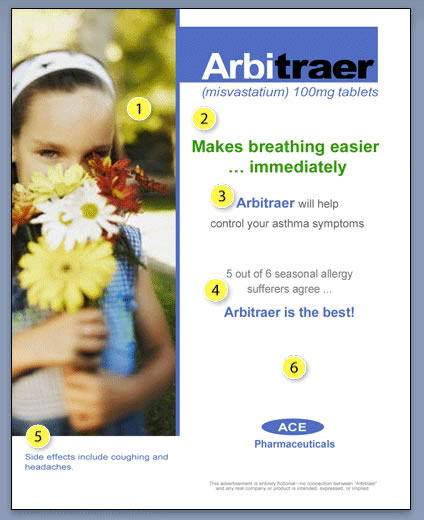
What a beautiful print ad! Here’s an ugly ad of the same drug:


Problems:

  1. Cannot use images of children if not approved for this age range
  2. This is a false claim that is not supported by well-designed studies
  3. Arbitraer is approved for seasonal nasal allergy symptoms, not asthma. Cannot make a claim that it will control asthma symptoms
  4. As stated above, claims must be supported by well-designed studies
  5. Risk information is in small type size and positioned far away from the benefits. “Fair balance” requirement not met.
  6. No “brief summary” about risk information, and no information about reporting adverse events to Medwatch.

In a nutshell, the team I’m working with collaborates with marketing teams to keep all materials in line with the FDA rules and regulations. That’s nice, Eric. What if I don’t want to follow the rules? That’s fine…if you want to get slapped with a Notice of Violation or Warning Letter from the FDA’s Division of Drug Marketing, Advertising, and Communications (DDMAC; pronounced dee-dee-mak). More on those in the next post. Baby steps, my friend.

Eric Zhao

I am currently a summer intern in the Regulatory Affairs Department, and the opinions and positions expressed are my own and don’t necessarily reflect those of Abbott Laboratories.

Thursday, May 5, 2011

Abbott Laboratories

Hello World. This is Eric Zhao (incoming P4) checking into the Summer Experiences blog. I'll be interning at Abbott Laboratories in the Regulatory Affairs Department this summer, and I'll do my best to give you a taste of what the pharmaceutical industry has to offer.

Quick Note: Due to Abbott's new social media policies, I have to wait for clearance before I begin posting any details, so stay tuned.


Abbott: A Promise For Life
Abbott Park, IL

-Eric Zhao

Monday, June 21, 2010

Government Programs & Pharma Drug Presentations

Last week and this week I'm spending my time within Government Programs--Medicare Part D clinical formulary management. As my first task, I was given a binder and was told to read "chapter 6." This chapter includes drugs not covered by Medicare Part D and policies and procedures regarding formulary management such as negative changes and ANOC (annual notice of change).

The project assigned to me dealt with HRM's (high risk medications). As the title implies, HRM's are medications that should not be used in the elderly or be used with caution. I was responsible for comparing utilization PMPM (per member per month) between 2009 and 2010 of HRM's. The control group are HRM's not removed from formulary, and variable group are HRM's removed from formulary. Ideally we'd like to see utilization to decrease from 09 to 10.

***
Pharma Drug Presentations
So far, I've attended 3 drug presentations presented by drug companies for Cayston (aztreonam inhalation solution), Zyclara (imiquimod 3.75% cream) and Vimovo (esomeprazole and naproxen). Each presentation was an experience in and of themselves. It's like a formal ritual-- introductions are made, business cards exchanged left and right...I'm forming quite a collection of business cards. I've noticed that the drug companies send teams of 3: medical science liasion (PharmD), expert of therapeutic topic (MD and/or PhD) and national account manager (business person concerned with money). The expert gives a presentation on the pathophysiology of disease being treated and the drug product being promoted. My preceptors and I will interject with questions, and the whole time the national account manager is writing away notes of our comments/requests in a diary-like notebook. So the flow of the presentations are pretty smooth...until we come upon the clinical studies section. Here is often where my preceptors drill and nit pick the expert and MSL (medical science liaison). I realize at that time how MSL's really really need to be on top of their game of knowing the literature AND keep their composure at the same time. I give them credit for the heat they have to take.

Today a presentation was given on Vimovo. I am fairly familiar with this drug product since I created its drug monograph. So I already had some questions prepared beforehand since some details were not exactly complete when I was doing research. There were 2 studies mentioned in the package insert (PI) saying that some result was "statistically significant." However, no p-value was referenced. I searched ClinicalTrials.gov, Medline, and Vimovo's dossier but could not find the p-value! So I asked the presenter what the p-value was, thinking that my question isn't even that complicated, and she couldn't even answer my question. She even went on to tell me the studies weren't mentioned in the PI, so then I pointed it out to her...but yea, she said she would send me some data that would contain more details on the study.

Please note: I am not dissing the pharmaceutical companies...next week I am actually going to be working alongside a medical outcomes specialist from Pfizer as part of my internship. My internship is sponsored by AMCP and Pfizer, so I get to experience managed care pharmacy and industry. I am looking forward to next week because I want to hear the perspective of a pharmacist in industry and place it within the scope of my experiences thus far. I will also be going to various sites with my Pfizer guy so looking forward to the new experience!